Article translated by an automatic translation system. Press here for further information.
The Camino de Santiago with a dog: recommendations for an extraordinary adventure
30/11/2025
 Image:
Pexels
Image:
Pexels Making the Camino de Santiago with a dog is an alternative that many pilgrims choose. And the truth is that, if you are thinking about starting the adventure, it is a unique opportunity to include it in the plan, and to further strengthen the bond that unites you.
Because yes, it is possible to do so, there are no prohibitions that do not allow it. However, in order for everything to go as expected and the experience to be rewarding for you and your pet, it is necessary to organize everything in advance.
Traveling with a dog requires being very clear what conditions there may be. What will be their needs and how to ensure the welfare of the animal throughout the journey. So it should be you who has to adapt to the dog, and not the other way around.
In this article we have compiled a series of tips and information of interest that will serve as a guide for the preparations of the Camino, accompanied by your loyal four-legged friend. Let us begin!
The Camino de Santiago with a dog: keys to good pre-preparation
An optimal and complete organization of the trip cannot leave anything to chance and must encompass different aspects. Some related to the health status of the dog, to training or feeding, and others, to the elements that can not be missing in the luggage, for their care and to ensure their comfort.
Photo by christina0chiz
1. Veterinary review, necessary basic documentation and microchip
The first thing to do is to have a veterinary checkup. Having up-to-date information about your physical state, whether the vaccines are up to date or whether you have any health problem or previous injury, will be essential to know how you get to the beginning of the adventure and assess whether you can complete it without problems.
It must be kept in mind that an older dog, a puppy or a dog that has some physical limitation or disease, may not be prepared to carry out the pilgrimage. But if we decide to embark on it, it must be knowing that we will have to keep pace much slower or that we will have to help them by taking them in cars or carrying them with us in a backpack.
Among the documents that must be carried on the trip, you can not miss the canine passport or veterinary certificate with the vaccination card. The dog must also have a microchip implanted in order to be identified and to facilitate contact with its owner in case of loss.
2. Prevention against parasites
The Camino de Santiago runs through many natural areas and some cross forests. Being outdoors, the dog will be much more exposed to become infected with parasites both internal (worms, tapeworms, etc.) As external (fleas, ticks, mites, etc. ).
To avoid this, it has to be properly dewormed and protected. Internally with anti-parasite drugs prescribed by the veterinarian, and externally, with shampoos, pipettes or repellent collars that help combat fleas and ticks.
3. Training, acclimatisation and emotional state
The journey will last several days and you will have to face longer, more demanding or more difficult sections of the route.
In order for your dog to withstand stress well and withstand every day without setbacks, it is necessary to train weeks before. You can start with shorter walks on a regular basis, to increase them in time and intensity.
It is necessary to test him on different surfaces so that his legs become accustomed and observe how he responds to the differences in terrain and temperature.
It is also important to assess your mental disposition. Know if you will be able to face unexpected events such as changes in time or days of excessive tiredness. In this sense, you should know that patience, positive accompaniment and flexibility if problems of this type arise, will be fundamental to continue the adventure in the best way.
4. Canine luggage.
Just as we have to prepare the backpack with a series of basic and essential things, the dog will also need its own luggage.
A harness (more comfortable than a collar) and a robust strap that allows you to handle it well in areas with many pilgrims or if there are cattle nearby must be included among their belongings.
You can’t miss boots or leg protectors either. Essential for the pads not to be damaged or injured when walking on hot asphalt or in irregular and difficult terrain.
In addition, you should not forget a raincoat to protect it from rain and a quick drying towel. Of greater need in the regions of the Camino de Santiago where it can rain more or the weather can be unstable. Cleaning your fur if it’s too wet, or if it gets dirty during a walk, is essential because wet dogs can catch a cold easily.
[Caption id="installation_152920" align="alignnone" width="996"]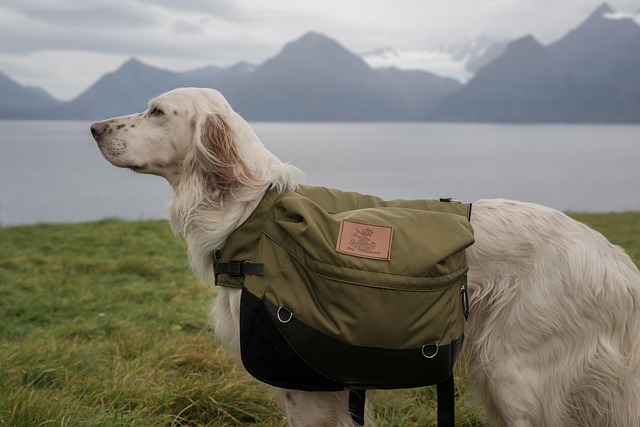 Photo by terjeaeriksen[/caption]
5. Food and care.
For the daily care of the can, it will be essential to carry enough quality food. It is advisable that it is distributed in different takes throughout the day so that it maintains the energy.
We'll also need a collapsible water drinker. Giving him a drink at the stops to rest will ensure that he is well hydrated.
Another essential element is to prepare a small medicine cabinet. It should include, among other things, bandages and gauze, plaster, healing ointments and antiseptics to treat possible wounds, physiological serum in single doses and any specific medication that the dog may require.
Selection of the appropriate route
Selecting which route is the most suitable to carry out the Camino de Santiago with the company of a dog requires information very well.
There are 12 official routes, and a total of 172 stages, each with its own characteristics to be discovered and analyzed. The level of ease, their accessibility, their extent, the environment in which they run, and, if they are animal-friendly, they are some of them.
In our Guide to the Camino de Santiago, you have all the details available that will allow you to choose the one that best suits you and your dog, depending on the time available to complete the journey.
dog friendly accommodations
Finding accommodation where dogs are allowed is one of the most important parts of the trip. A suitable accommodation will be one that cares about the comfort and well-being of the pet, but also about good coexistence with other pilgrims.
The places in hostels, hostels and hotels that allow dogs, can be limited, and, to avoid missing one, it is essential to book well in advance. Especially in the high season months, such as the summer months.
When contacting the establishments it is advisable to facilitate the breed, size and weight of the dog, in case there could be any inconvenience. As well as ask them for details about the specific regulations they have on animals, because it can vary from one accommodation to another.
Credential and Compostela Canina
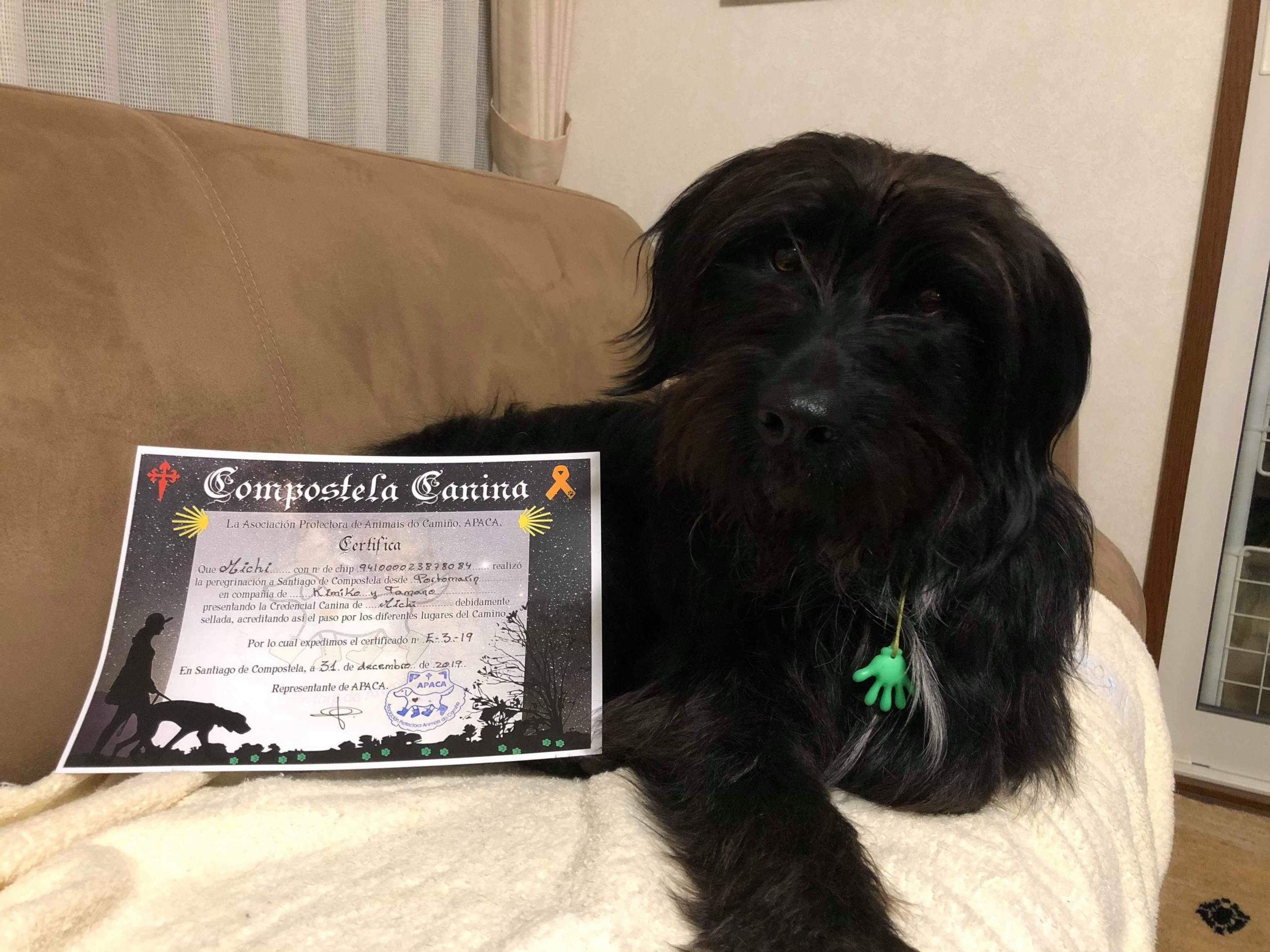
Photo of paradoxahumana
Photo of paradoxahumana
In recent years the number of pilgrims who make the Camino with their dogs has increased so much that the Credential and the Compostela Canina or Perregrina is a reality since 2018.
The initiative was promoted by the Protective Association of Animais do Camiño (APACA). Although it does not have an official character, it is a way to recognize in a special way the effort of four-legged hairdressers and that the Camino de Santiago, why not?, is also for them.
APACA has a very important role in the regulation and care of the animals that make the Camino. It promotes and facilitates pet registration, offers information of interest and tips to dog owners to prepare for the trip, about pet friendly accommodations, and helps with obtaining the Credential and Canine Compostela.
To obtain the Credential or the Perregrino passport it is necessary to first register the dog with its documentation and then request it in APACA or at the points established for it along the Camino (specialized stores in animals, hostels, hostels, offices of Tourism and Pilgrim Care, associations, etc. ).
The Credential works in the same way as people’s. It is a document that consists of boxes that must be stamped at the end of each day in accommodations, tourist offices, town halls, bars and restaurants, etc. La Compostela is obtained when you arrive at the end of the Camino, in Santiago, after showing the credential correctly sealed.
The Credential and the Compostela for dogs have a cost of 3€ each, and all the money that is collected has a solidarity purpose. It is used to help abandoned animals on the Camino.
🐾 Doing the Camino de Santiago with your dog as a traveling companion will be a formidable way to connect with him and enjoy as never before, while adding new and enriching experiences together. A memorable adventure that, without a doubt, you will remember forever.