Article translated by an automatic translation system. Press here for further information.
Stage from O Cebreiro to Triacastela
Renew your strength in this short stage and visit the Church of San Xoán
Information about the stage 25: Stage from O Cebreiro to Triacastela
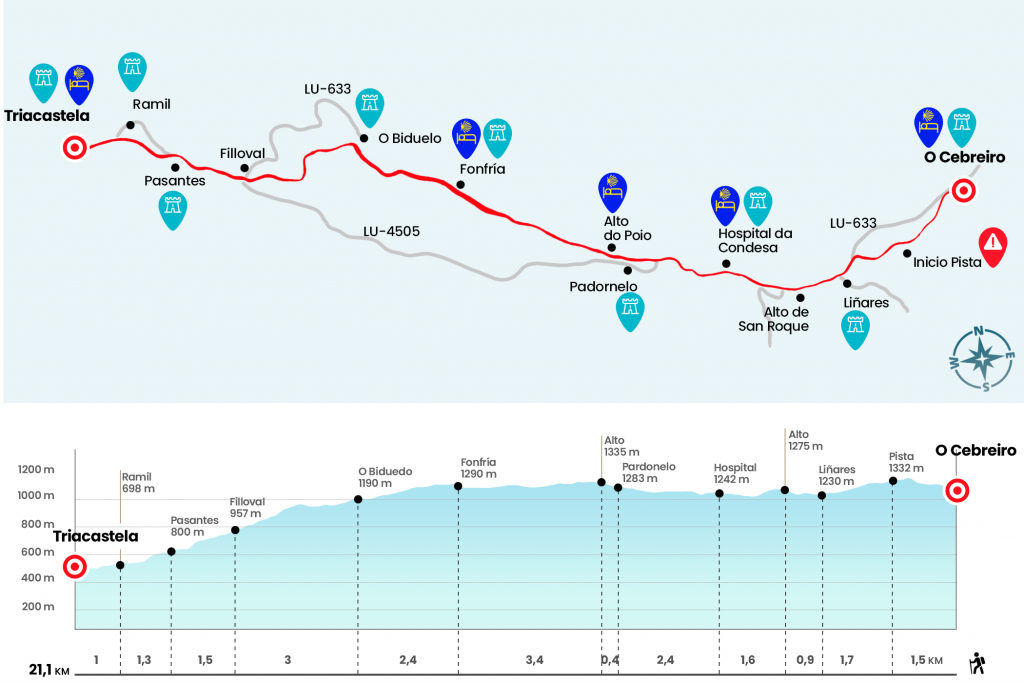
Enlarge map
Points of interest in the stage 25: Stage from O Cebreiro to Triacastela
The route
- Km 28.4. O Cebreiro (Hostel. Rural Houses and Pensions. - Bars. Bars. Shop)
If the fog does not prevent it by hiding the valley, seeing sunrise from O Cebreiro, next to the temple of Santa María la Real, is a privilege that gives us the Way that we can not refuse. Today, at last, we are immersed in the land of Santiago, that of the mist and the orballo; that of the Celtic castros and the mines desired by the Romans; of an infinite number of hills, fragas of oaks and souts of chestnut trees. The official signage marks 151 kilometers to Santiago, ours 154.7. We started the twenty-fifth stage above the pilgrims' hostel. Sheltered by the vegetation of the mountain, we ascend from 1296 meters to 1370 (the highest point of the Camino Frances in Galicia) in the vicinity of Teso da Cruz and Mount Area. From that point we went down to find a wide forest track (Km 1.5).
Drive to the first parish of the day. In Galicia the municipalities are called concellos, to which belong different parishes that in turn encompass different places or villages. To the south, on the left hand side of the forest track, the view is recreated in an endless number of tumpy hills of ferns, oaks, chestnut trees and grasslands that form, among others, the mountains of O Courel. The forest track opens at the foot of the LU-633, where the parish of Santo Estevo de Liñares, with a pre-Romanesque church of a single nave, is located.
- Km 3.2. Liñares (Hostel. Bar that does not serve meals. Shop)
After the temple we cross the LU-633, faithful companion during today's stage, and we take a path very close to the road that overlooks us with its beeches, acebos and other catalog of Atlantic species. The first stop, that of San Roque, does not take long to arrive. On the other side of the LU-633, at 1270 meters and before a wide panoramic view, stands the plastic sculpture of a medieval pilgrim who advances against the wind. It was immortalized in bronze by the artist José María Acuña (Km 4,1).
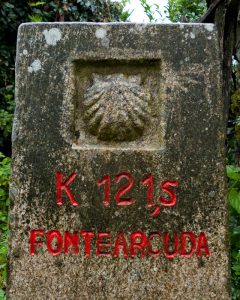
The path follows the itinerary of the LU-633 and descends slightly to 1,205 meters. Subsequently, a false plain approaches us to Hospital da Condesa, the second inhabited nucleus of the day. The Jacobean mojón marks the 145.5. In this town we will probably have one of the first contacts with the "Galician blondes", the cinnamon cows appreciated for their meat.
- Km 5.7. Hospital da Condesa (Hostel. Bar)
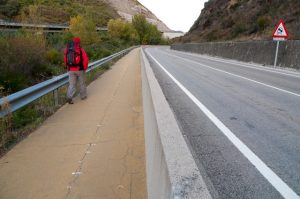
We left this cowboy village and continued along a path that led to the guardarrail of the LU-633. Later on we took the detour to Sabugos and Temple but we immediately dismissed the paved section along a road that brings us closer to Padornelo. It's the kingdom of stone and slate slabs.
- Km 8.1. Padornelo
At the exit of this small parish we face a very hard but brief cost for which we reach the alto do Poio. A bar - hostel and a inn strategically receive the walkers, eager to stabilize their heart rate after such an acceleration.
- Km 8.5. Alto do Poio (Hostel. Bars)
More than three kilometers of path attached to the LU-633 separate us from the next population. In this whole section we practically flat because we only descend 45 meters of altitude. That’s how we got to Fonfria, the centre of Pedrafita do Cebreiro, with bars and a hostel. If we pass relatively early and have not yet opened the bars, it is likely that some locals will welcome us with a succulent tower of fried milk cakes.
- Km 11.9. Fonfria (Hostel. Bar)
We cross Fonfria and again, next to the inseparable LU-633, we return to the path that takes us through the identical landscape until O Biduedo, 2.4 kilometers away. In all this section we descend exactly one hundred meters (Km 14.3).
- Km 14.3. O Biduedo (Bar)
After O Biduedo, already from the Concello de Triacastela, the descent begins to become evident. We are only 6.8 kilometres away from the end of the stage and we still have to go down about 530 metres in altitude. On the descent, the road tries to detach from the LU-633 and cut through the turns and turns of the road. A sharp bend allows us to see from the front Mount Oribio, 1443 meters high. To the right, at the bottom of the valley, is Triacastela. The village after O Biduedo is Fillobal. In this village there is a hostel and a bar-restaurant, the Aira do Camiño, with an internet access point and a small shop.
- Km 17.3. Fillobal (Hostel. Bar)
After Filloval we crossed the road and continued descending through trees to cross it again a kilometer later, next to a small picnic area. Thus we entered into Pasantes (Km 18,8), a stretched village with a chapel that we passed through under the demand of the private sale of raspberries. The day continues to the village of Ramil (Km 20,1), with centenary chestnut tree on the edge of the road, and almost attached to Triacastela. The public hostel is located at the same entrance, in a campsite on the left hand side and the rest, a large assortment of private hostels, in the center of the population.
- Km 21,1. Triacastela (All Services)
The difficulties
Remarks
In images
What to see, what to do
The hostels

¿Do you want to send any photo of "The Camino de Santiago"?
If you have any photos of "El Camino de Santiago" that you want to share with us, you can send them to us and enlarge the photo gallery
Forum: What pilgrims think about the Camino de Santiago
See all